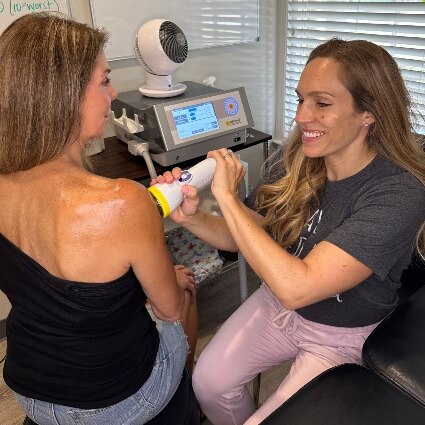
Hip pain shows up in ways people do not expect — pain lying on one side at night, a deep ache with stairs, tightness that stretching never fully solves. Shockwave therapy is one non-surgical option for the soft-tissue side of hip pain, and we use SoftWave.
Tendon irritation on the outside of the hip and chronic soft-tissue pain around the joint are common, frustrating, and often mislabeled. They also tend to respond poorly to rest alone, because walking and sitting are unavoidable.
Shockwave is aimed at that soft-tissue component — not at replacing an orthopedic evaluation when joint degeneration is the primary driver.
Pain on the outside of the hip when lying on that side
Deep ache with stairs, standing, or walking
Hip and glute tightness that returns after stretching
Pain that has lasted months despite therapy or rest
How SoftWave Fits Into the Shockwave Category
The hip is surrounded by thick tissue, and pain is rarely confined to one small point. Broad-focused shockwave treats a wider area at once, which suits the region.
What the Evaluation Looks Like
Your first visit lasts about 30 minutes. It includes a consultation, a hands-on exam, and a mapping session that uses biofeedback to locate the tissue that is actually irritated — which is not always where you feel the pain. We have an onsite digital X-ray suite if imaging is warranted.
At the follow-up we review what we found and give you a specific recommendation: how many sessions, how often, and what else (chiropractic care, decompression, movement work) belongs alongside it. Treatment sessions themselves usually take about 10 minutes.
Who Is — and Isn't — a Candidate
Shockwave therapy is worth evaluating when hip pain has persisted despite rest, stretching, or other conservative care, and when the tissue involved is one that responds to a regenerative stimulus.
It is generally not appropriate during pregnancy, over open growth plates, over tumors or active infections, for people with clotting disorders or on blood thinners, or directly over implanted devices. If you are not a good fit, we will tell you and point you toward the care that makes more sense.
What the Research Says
Extracorporeal shock wave therapy (ESWT) has been studied across tendon and soft-tissue conditions for more than two decades, and the SoftWave device carries FDA clearance in the United States. Published results vary by condition, device type, and protocol.
We will not promise you an outcome. What we can do is examine you, explain honestly whether the evidence supports trying shockwave for your particular problem, and measure whether it is working as we go.
Schedule an Evaluation in Dunwoody
Hip pain has several possible sources, and the right treatment depends on which one you have. Call (770) 452-0022 for an evaluation.
Common Questions
Is SoftWave the same thing as shockwave therapy?
Yes. SoftWave is a brand of shockwave therapy. It is not a separate category of treatment — it is one particular type of shockwave technology, so when you search for shockwave therapy in Dunwoody, SoftWave is what our office provides.
Is SoftWave radial shockwave therapy?
No. Radial devices create pressure waves at the skin surface that lose energy as they travel deeper. SoftWave generates a true shock wave and delivers it across a broad area, which is a different mechanism than radial pressure-wave devices.
Does shockwave therapy hurt?
Most people describe it as a firm tapping or thumping sensation. It can be tender over an irritated area, and your provider can adjust the intensity during the session. It is non-invasive, requires no anesthesia, and there is no recovery downtime.
What conditions do chiropractors use shockwave therapy for?
Commonly plantar fasciitis, Achilles tendon problems, knee pain, shoulder problems, tennis and golfer's elbow, hip pain, wrist and hand pain, and stubborn chronic back and neck pain that has not responded to other conservative care.
Who should not receive shockwave therapy?
Shockwave is generally avoided during pregnancy, over open growth plates in children, over tumors or active infections, in people with blood-clotting disorders or on blood thinners, and directly over implanted devices. We screen for these during your evaluation and will tell you honestly if you are not a good candidate.