Tennis elbow rarely comes from tennis. It comes from repetition — grip, lifting, keyboards, tools — and it is famously slow to resolve. Shockwave therapy is one of the better-studied conservative options, and our Dunwoody office uses SoftWave.
The tendons at the elbow are small, heavily used, and hard to rest in daily life. Pain that started as a nuisance can become a months-long problem simply because the tissue never gets a break.
Shockwave is used here to introduce a healing stimulus to tendon tissue that has stopped remodeling on its own.
Pain on the outside of the elbow with gripping (tennis elbow)
Pain on the inside of the elbow with gripping or lifting (golfer's elbow)
Weak grip or pain lifting a coffee cup
Elbow pain that keeps returning with normal daily use
How SoftWave Fits Into the Shockwave Category
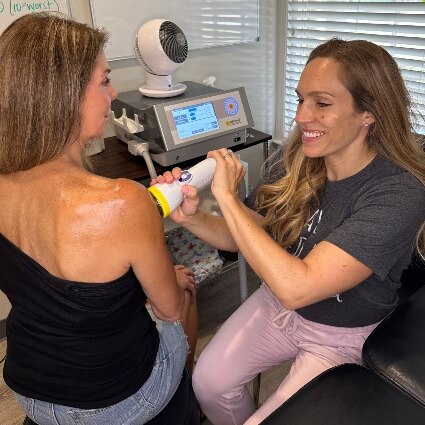
SoftWave delivers a true shock wave across a broad area. At the elbow, that generally means a comfortable session without the numbing that some tightly focused protocols require.
What the Evaluation Looks Like
Your first visit lasts about 30 minutes. It includes a consultation, a hands-on exam, and a mapping session that uses biofeedback to locate the tissue that is actually irritated — which is not always where you feel the pain. We have an onsite digital X-ray suite if imaging is warranted.
At the follow-up we review what we found and give you a specific recommendation: how many sessions, how often, and what else (chiropractic care, decompression, movement work) belongs alongside it. Treatment sessions themselves usually take about 10 minutes.
Who Is — and Isn't — a Candidate
Shockwave therapy is worth evaluating when elbow pain has persisted despite rest, stretching, or other conservative care, and when the tissue involved is one that responds to a regenerative stimulus.
It is generally not appropriate during pregnancy, over open growth plates, over tumors or active infections, for people with clotting disorders or on blood thinners, or directly over implanted devices. If you are not a good fit, we will tell you and point you toward the care that makes more sense.
What the Research Says
Extracorporeal shock wave therapy (ESWT) has been studied across tendon and soft-tissue conditions for more than two decades, and the SoftWave device carries FDA clearance in the United States. Published results vary by condition, device type, and protocol.
We will not promise you an outcome. What we can do is examine you, explain honestly whether the evidence supports trying shockwave for your particular problem, and measure whether it is working as we go.
Schedule an Evaluation in Dunwoody
If your elbow has been sore for more than a few weeks, get it looked at. Call (770) 452-0022 to schedule an evaluation.
Common Questions
Is SoftWave the same thing as shockwave therapy?
Yes. SoftWave is a brand of shockwave therapy. It is not a separate category of treatment — it is one particular type of shockwave technology, so when you search for shockwave therapy in Dunwoody, SoftWave is what our office provides.
What is broad-focused shockwave therapy?
Broad-focused shockwave therapy delivers true acoustic shock waves over a wider treatment zone rather than concentrating them at a single small point. The intent is to reach a larger volume of tissue in one session while keeping the treatment comfortable.
Does shockwave therapy hurt?
Most people describe it as a firm tapping or thumping sensation. It can be tender over an irritated area, and your provider can adjust the intensity during the session. It is non-invasive, requires no anesthesia, and there is no recovery downtime.
How many SoftWave treatments do people typically receive?
It depends on the tissue involved, how long the problem has been there, and your goals. Care plans are commonly delivered as a series of sessions spaced over several weeks. We give you a specific recommendation after your evaluation rather than a one-size-fits-all package.
Is shockwave therapy covered by insurance?
Most insurance plans do not currently cover shockwave therapy, so it is usually paid out of pocket. Coverage varies by plan, and HSA or FSA funds can often be used. Ask our team and we will help you check.